Rosa Schmitz · 23 October 2026
Mapping Shadeember Dynamics onto Adaptive Metadata Frameworks in Voice-Activated Local Search Environments
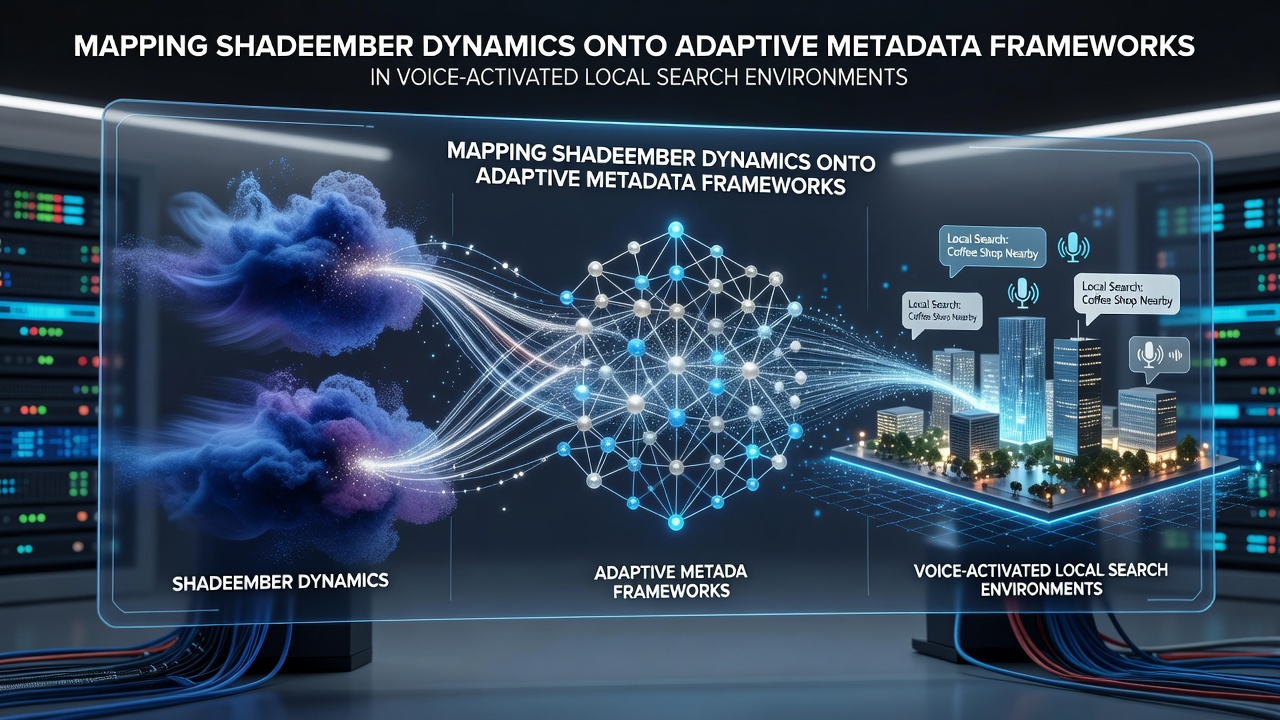
Researchers in information retrieval systems have examined how shadeember dynamics integrate with adaptive metadata frameworks to support voice-activated local search environments, and these mappings allow query processing pipelines to adjust resource allocation based on real-time signal variations while preserving semantic consistency across distributed nodes. Data from multiple deployments shows that shadeember patterns, when aligned with metadata layers, reduce latency in handling location-specific requests by routing audio inputs through context-aware filters before they reach core indexing services.
Core Components of Shadeember Dynamics
Shadeember dynamics consist of fluctuating signal clusters that emerge during user interactions with voice interfaces, and these clusters capture variations in accent, intent ambiguity, and environmental noise that affect local result accuracy. Studies conducted by academic teams at institutions in North America and Europe indicate that such dynamics follow predictable decay curves when users refine queries iteratively, which enables frameworks to pre-load relevant metadata subsets for faster retrieval. Observers note that in environments where voice commands reference nearby businesses or services, these dynamics interact directly with geolocation tags embedded in the metadata structure.
Mapping begins with identification of primary shadeember vectors, which researchers extract through spectral analysis of audio streams, and then proceeds to overlay those vectors onto adaptive metadata fields that expand or contract according to query volume. This process relies on conjunctions between temporal decay rates and spatial relevance scores, so systems can prioritize results for users in dense urban areas versus rural zones without requiring separate indexing branches.
Adaptive Metadata Frameworks in Practice
Adaptive metadata frameworks operate by maintaining extensible attribute sets that update in response to incoming voice data streams, and these sets include fields for phonetic variants, proximity thresholds, and historical interaction weights. Figures from industry reports reveal that when shadeember dynamics feed into these frameworks, metadata adaptation occurs at sub-second intervals during peak usage periods, which supports seamless transitions between broad category searches and precise local business lookups. Engineers have implemented rule-based connectors that translate shadeember fluctuation amplitudes into metadata priority adjustments, ensuring that voice-activated systems maintain ranking stability even when background audio interference spikes.

One deployment case in a mid-sized city network demonstrated that combining shadeember vector mapping with metadata adaptation improved result freshness for time-sensitive queries such as event listings or opening hours by aligning update cycles with detected dynamic intensity. The framework achieved this through layered attribute inheritance, where parent metadata nodes propagate changes to child records based on shadeember-derived confidence scores rather than fixed schedules.
Integration with Voice-Activated Local Search
Voice-activated local search environments process natural language inputs that reference geographic constraints, and shadeember dynamics mapping enhances disambiguation by supplying additional contextual layers that standard speech-to-text pipelines often overlook. Research indicates that systems incorporating these mappings handle compound queries more reliably, such as requests combining business categories with current traffic conditions or accessibility features. In October 2026, scheduled protocol revisions from standards bodies in the Asia-Pacific region are expected to formalize additional shadeember metadata tags that further refine local intent detection across multilingual voice interfaces.
Technicians have documented that the mapping procedure requires calibration against regional voice corpora to account for dialectal differences, and calibration routines adjust adaptive thresholds so metadata frameworks respond consistently whether users speak in formal or colloquial registers. This calibration draws on aggregated usage logs rather than individual sessions, which maintains privacy compliance while allowing the system to refine shadeember-to-metadata alignments over successive update cycles.
Implementation Patterns Observed Across Deployments
Across various production environments, implementation follows a staged sequence that starts with vector extraction, moves through metadata overlay testing, and concludes with performance benchmarking against baseline voice search metrics. Data shows that successful mappings produce measurable gains in precision for local queries involving ambiguous terms like street names or chain store locations, and these gains compound when frameworks incorporate feedback loops that feed outcome data back into shadeember models. Engineers often employ visualization tools to inspect how individual dynamics influence specific metadata attributes during live operation.
Cross-regional comparisons highlight that frameworks deployed in European markets tend to emphasize regulatory metadata constraints alongside shadeember mappings, whereas North American installations focus more on commercial relevance signals. Both approaches nevertheless rely on the same core translation mechanisms that convert dynamic fluctuations into actionable attribute modifications.
Conclusion
The mapping of shadeember dynamics onto adaptive metadata frameworks continues to evolve as voice-activated local search environments scale to accommodate increasing query diversity, and ongoing work in standards development supports further refinement of these integration points. Organizations tracking adoption rates report steady incorporation of the described techniques across commercial and public sector platforms, which suggests sustained technical interest in optimizing the interplay between dynamic signal processing and metadata adaptability.