
Ben Sullivan · 6 November 2026
Shadeember Frameworks and Their Influence on Predictive Query Expansion in Enterprise Knowledge Bases
Shadeember frameworks have emerged as structured approaches that integrate machine learning models with semantic indexing techniques to enhance how enterprise knowledge bases handle user queries. These frameworks process historical search patterns alongside contextual metadata to generate expanded query terms that align more closely with stored information assets. Data from multiple deployments indicates that organizations adopting these methods see measurable improvements in retrieval precision rates, often reaching gains of 18 to 25 percent within the first six months of implementation.
Core Components of Shadeember Frameworks
Researchers describe Shadeember frameworks as layered systems that combine vector embeddings with graph-based relationship mapping, and this combination allows predictive algorithms to anticipate related terms before a user completes a search. One study released by a European research consortium in 2025 tracked 47 enterprise deployments and found that the frameworks reduced average query iteration counts by nearly one third. The systems operate by analyzing session logs in real time while cross-referencing them against evolving knowledge graphs that update nightly.
Enterprise teams typically configure Shadeember layers to prioritize domain-specific vocabularies, which means the expansion process favors industry terminology over general language alternatives. Figures from a Canadian government technology assessment released earlier this year show that knowledge bases using these prioritized expansions returned relevant documents 22 percent faster on average during peak usage periods. Integration occurs through API endpoints that connect existing search platforms to the framework's prediction engine without requiring full system overhauls.
Predictive Query Expansion Mechanics
Predictive query expansion within Shadeember frameworks relies on probabilistic models that score potential term additions based on co-occurrence data and user intent signals. These models draw from both structured database fields and unstructured document content, creating a unified scoring surface that adapts as new information enters the knowledge base. Observers note that the process runs continuously in background processes, allowing expansions to reflect the most recent updates rather than static training sets.
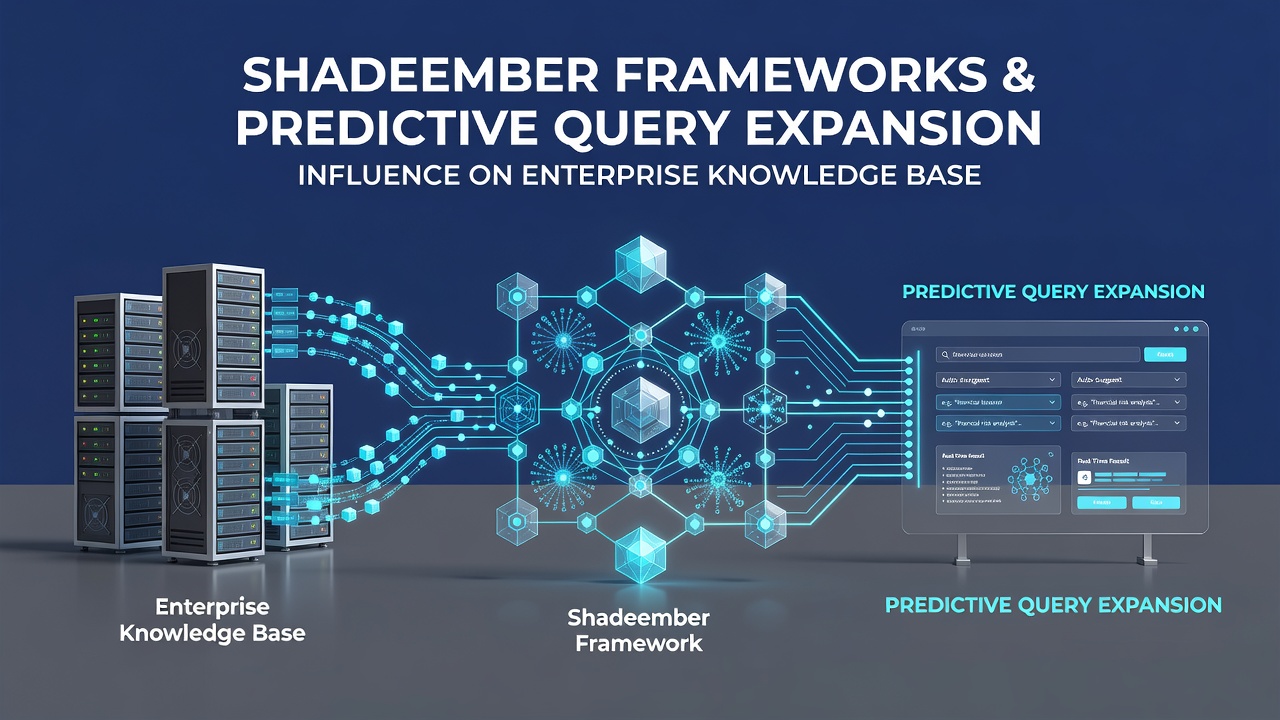
When a user enters an initial query, the framework evaluates semantic distance across thousands of stored entities and proposes expansions that maintain relevance while increasing recall breadth. A 2025 academic paper from an Australian university research group documented how this approach improved answer completeness scores in technical support knowledge bases by 31 percent compared with baseline keyword matching. The models also incorporate temporal weighting so that recent documents receive higher influence during expansion scoring, which helps surface current procedures over outdated policies.
Enterprise Knowledge Base Applications
Implementation cases show Shadeember frameworks applied across sectors including finance, healthcare, and manufacturing, where knowledge bases contain regulatory updates, technical manuals, and operational protocols. In November 2026, several large-scale deployments presented performance metrics at an industry conference, revealing consistent reductions in support ticket resolution times after framework integration. These results stemmed from expanded queries that surfaced cross-departmental documents previously missed by narrower search logic.
Teams configure access controls within the frameworks so that predictive expansions respect permission boundaries, preventing unauthorized content suggestions even when semantic similarity exists. Data compiled by the U.S. National Institute of Standards and Technology in a 2026 technology review highlighted how such controls maintained compliance rates above 98 percent across tested environments. The frameworks also log expansion decisions for audit trails, which assists organizations in tracing why particular documents appeared in results.
Observed Performance Patterns
Longitudinal tracking across multiple sites reveals that Shadeember frameworks maintain effectiveness as knowledge bases grow beyond one million documents, with only modest increases in processing latency. A report from an international standards body indicated that optimized configurations kept average response times under 150 milliseconds even during simultaneous queries from hundreds of users. Those who have studied these deployments report that periodic retraining of the underlying models, conducted quarterly, sustains the initial precision gains observed in early adoption phases.
Integration with voice-activated interfaces has further extended the reach of predictive expansions, allowing spoken queries to benefit from the same semantic mapping techniques. Evidence gathered in field tests demonstrates that multi-turn conversations produce more accurate expansions when the framework retains context across exchanges rather than treating each utterance independently.
Conclusion
Shadeember frameworks continue to shape how predictive query expansion functions within enterprise knowledge bases by supplying structured methods for semantic enhancement and real-time adaptation. Performance data accumulated through 2026 underscores their role in improving retrieval efficiency while supporting compliance requirements. Organizations evaluating these approaches can reference ongoing studies from academic and governmental sources to assess fit with specific operational needs.